

News vs. Opinion
Why Knowing the Difference Matters More Than Ever

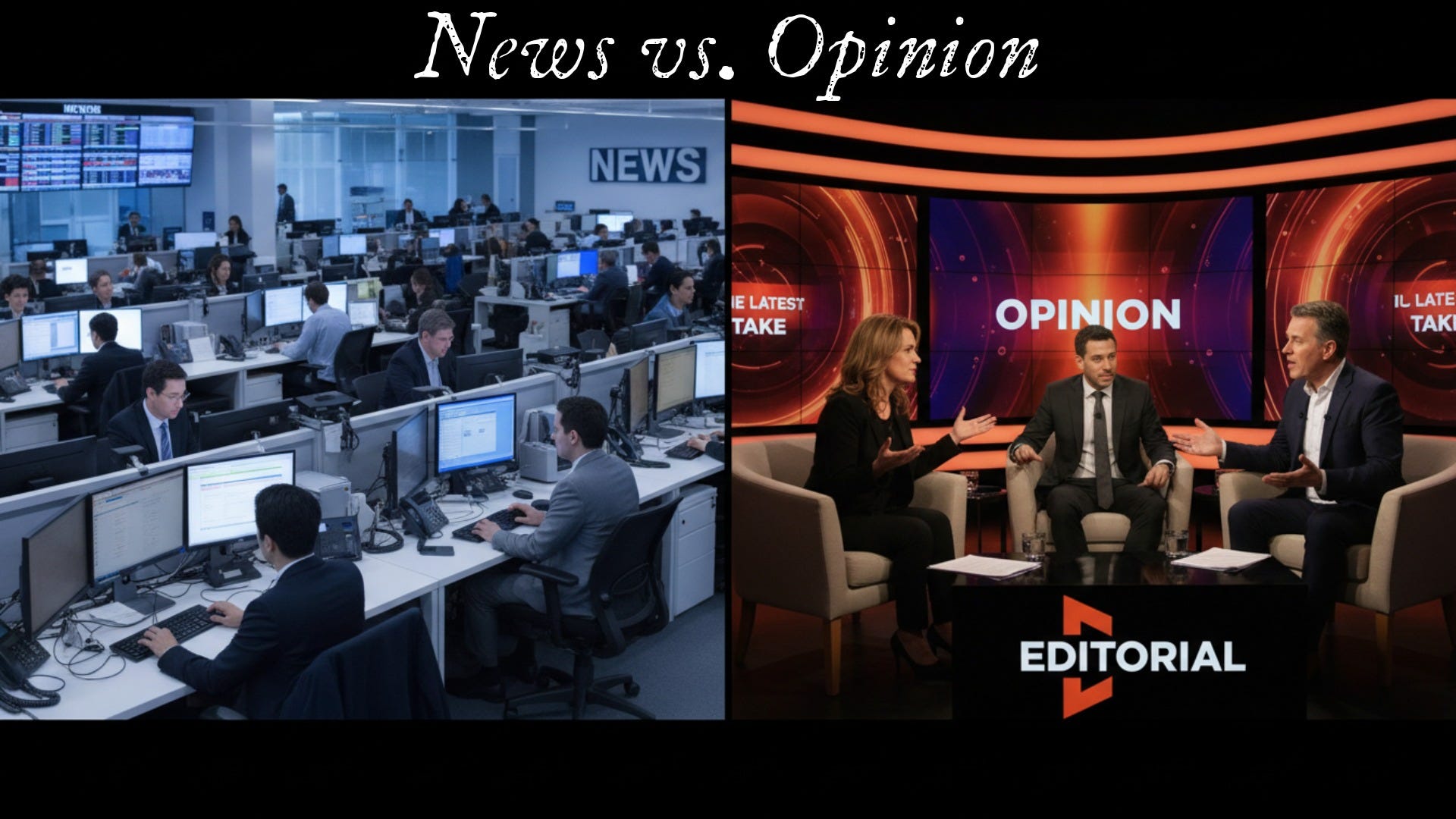
Let me tell you about a conversation I had with my neighbor last week. She was furious about something she’d “read in the news” about local politics. When I asked her where she saw it, she said, “You know, that guy on the evening show. The one who tells it like it is.”
I cringed. That guy wasn’t reporting the news. He was giving his opinion about it.
And honestly? I can’t blame my neighbor for the confusion. The line between news reporting and opinion has become so blurred that even media-savvy folks sometimes struggle to tell the difference. And don’t even get me started on how AI has further complicated things (that’s a rant for another time). If you’ve ever found yourself in a similar situation, wondering whether you just consumed facts or someone’s personal take on those facts, you’re not alone.
What makes a news article a news article?
During my years as a reporter, I learned one fundamental rule that governed everything I wrote. My personal opinions had no place in a news story. None. Zero. Zilch.
That’s not to say that reporters don’t have personal biases. We just learn to tuck them away and not let them affect our reporting.
A proper news article is built on a foundation of facts, quotes from relevant sources, and verifiable information. Think of it as a recipe where the only ingredients are who, what, when, where, why and how. No editorial seasoning allowed.
Here’s what you’ll find in a legitimate news article:
Objective reporting of events. The reporter describes what happened without injecting their own feelings about it. If a city council voted to approve a new budget, the news article tells you they voted, what the vote count was, what’s in the budget, and what happens next. It doesn’t tell you whether the vote was a brilliant decision or a catastrophic mistake.
Multiple sources and perspectives. Good journalism includes voices from different sides of an issue. You’ll see quotes from the council members who voted yes, those who voted no, and perhaps citizens affected by the decision. The reporter isn’t picking a side. They’re presenting the full picture.
Attribution for claims and statements. Every assertion gets tagged with its source. You won’t see “the new policy will destroy local businesses.” You’ll see “local business owner Jane Smith said the new policy could hurt her bottom line.” Notice the difference? One is the reporter’s assertion. The other is a sourced statement.
Neutral language. News writing avoids loaded words designed to trigger an emotional response. Compare “the council slashed the education budget” with “the council reduced the education budget by 15%.” The second version sticks to the facts without the dramatic flair.
The inverted pyramid structure. This is journalism school 101. The most important information comes first, with details becoming progressively less critical as you read down. This structure serves a practical purpose. Editors can cut from the bottom if space is tight without losing the essential facts.

When Opinion Enters the Picture
Now, let’s talk about opinion pieces—which include newspaper columns, letters to the editor, editorial board opinions, and yes, those evening talk show hosts everyone loves to watch.
Opinion pieces serve a different purpose entirely. They’re designed to persuade, analyze, critique, or advocate for a particular viewpoint. And there’s nothing inherently wrong with that. Opinion journalism has a rich tradition in American media, from the Federalist Papers to modern-day columnists who help us make sense of complex issues.
But here’s where things get tricky.
Opinion pieces often reference the same events that news articles cover. They just approach them from an entirely different angle. While a news article tells you what happened at that city council meeting, an opinion piece tells you what the columnist thinks about what happened (and why you should think the same way).
Opinion pieces include the writer’s perspective and judgment. That’s literally the point. The writer is saying, “Here’s what I think, and here’s why I think it.” There’s an “I” or “we” in the equation that doesn’t exist in straight news reporting.
Persuasive language is not only allowed but expected. Opinion writers use rhetorical devices, emotional appeals, and colorful language to make their arguments compelling. They’re trying to convince you, not just inform you.
Selective use of facts to support an argument. While ethical opinion writers don’t fabricate information, they do choose which facts to highlight based on the point they’re making. A news article about that budget vote would mention both the proposed tax increase and the expanded services it would fund. An opinion piece opposing the budget might focus heavily on the tax increase while giving less attention to the services.
Analysis and interpretation. Opinion writers connect dots, predict outcomes, and explain significance in ways that news reporters can’t. “This vote represents a fundamental shift in the council’s priorities” is an analytical statement you’d find in an opinion piece, not a news article.
The Talk Show Hosts: Opinion Makers, Not News Reporters
This brings us to what might be the most confusing category for many media consumers: television and podcast talk show hosts who discuss current events.
I’m talking about your Tucker Carlsons, Rachel Maddows, Sean Hannitys, and Joy Reids of the world. These folks have massive audiences. They sit behind news-style desks. They discuss the day’s events. They often have “breaking news” graphics behind them.
But make no mistake—they’re opinion hosts, not news reporters.
These programs fall squarely in the opinion category, even when they’re broadcast on networks that also produce legitimate news coverage. The hosts editorialize, which means they offer commentary and analysis shaped by their own political viewpoints and ideological frameworks.
Here’s what makes talk show hosts different from news anchors:
They openly advocate for positions. A news anchor reports that Congress is debating a healthcare bill. A talk show host tells you why that bill is either going to save American healthcare or destroy it completely (and they’re not shy about which position they hold).
They use inflammatory language and rhetoric. This is entertainment as much as information. The hosts know that passion and personality keep viewers engaged. You’ll hear words like “disaster,” “betrayal,” “brilliant,” and “courageous,” value judgments that have no place in news reporting.
They select guests who support their viewpoint. While some shows occasionally include opposing voices, the deck is often stacked. The host brings on experts, politicians, and commentators who generally align with their perspective. Even when they include someone from “the other side,” it’s often set up as a debate to be won rather than an exploration of different viewpoints.
They interpret events through an ideological lens. Conservative talk show hosts and liberal talk show hosts can cover the same event and present completely different narratives about what it means and why it matters. Neither is necessarily lying, but both are filtering facts through their political worldview.
Does this mean talk show hosts are bad or dishonest? Not at all. But it does mean you need to consume their content with different expectations than you’d bring to a news broadcast. They’re providing analysis and persuasion, not objective reporting.
Why the Confusion Exists
If the distinction between news and opinion is so clear, why do so many people struggle with it?
Several factors have made this more complicated:
The 24-hour news cycle demands content. There aren’t enough hard news events to fill 24 hours of programming, seven days a week. Networks fill the gaps with analysis, commentary, and opinion. Over time, the boundaries have blurred.
Opinion content is more profitable. People tune in to hear hosts who share and validate their existing beliefs. This tribalism drives ratings, which drives advertising revenue. It’s a business model based on opinion, not news.
The decline of local newspapers. Traditional newspapers maintained strict separation between news and opinion. The news section reported facts; the opinion section published editorials and columns. As newspapers have struggled financially, many Americans have lost access to this model and turned instead to television and online sources where the boundaries are much murkier.
Social media amplifies opinion. When news gets shared on social media, it’s often shared with commentary. By the time you see it, you’re getting someone’s opinion about the news, not the news itself. And opinion content tends to be more shareable because it triggers emotional reactions.
Deliberate blurring by some outlets. Let’s be honest. Some media organizations benefit from the confusion. If their opinion hosts are perceived as news reporters, their arguments carry more weight.
How to Spot the Difference
Now that we’ve established what makes news and opinion different, here are some practical tips for identifying which you’re consuming:
Look at the source. Is this from the news section of the website or the opinion section? Is it labeled “analysis” or “commentary”? Many legitimate outlets clearly mark opinion content, but you have to pay attention to the labels.
Check for bylines and credentials. Opinion pieces usually carry a byline identifying the author and their credentials or perspective. News articles might have a byline too, but it won’t include editorial labels like “contributing opinion writer.”
Notice the language. Are you reading/hearing adjectives like “brilliant,” “misguided,” “dangerous,” or “inspiring”? Those are opinion signals. News uses more neutral descriptors.
Count the sources. A news article typically includes multiple sources with different perspectives. An opinion piece might cite sources, but they’re chosen to support the writer’s argument.
Ask yourself: Am I being told what happened, or am I being told what to think about what happened? This is the simplest test. If the content is explaining why something matters, what it means for the future, or what you should do about it—that’s opinion.
Look for the first person. If you see “I think,” “we believe,” or “in my view,” you’re definitely in opinion territory.
Why This Matters
You might be thinking, “Okay, so what? Does it really matter if I’m consuming news or opinion?”
It absolutely matters.
When you mistake opinion for news, you’re potentially building your understanding of the world on someone else’s interpretation rather than on verified facts. You’re letting someone else do your thinking for you.
This doesn’t mean opinion content is worthless—far from it. Good opinion writing helps us understand complex issues, consider different perspectives, and think critically about current events. I read opinion columns all the time, and they often challenge my thinking in valuable ways.
But I read them knowing they’re opinions. I don’t mistake them for objective reporting. That awareness lets me engage with the content critically, weighing the arguments against my own knowledge and values.
When you can distinguish between news and opinion, you become a more informed citizen. You can:
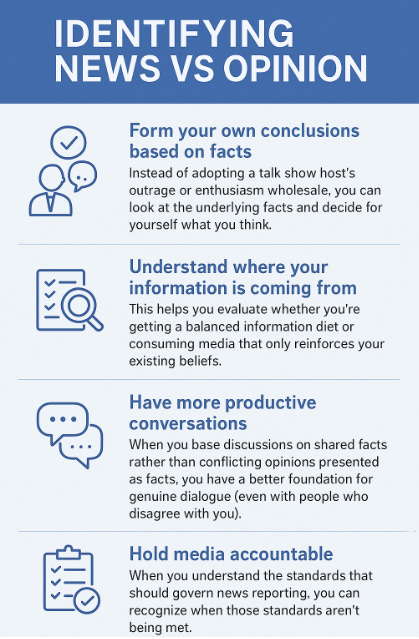
Form your own conclusions based on facts. Instead of adopting a talk show host’s outrage or enthusiasm wholesale, you can look at the underlying facts and decide for yourself what you think.
Understand where your information is coming from. This helps you evaluate whether you’re getting a balanced information diet or consuming media that only reinforces your existing beliefs.
Have more productive conversations. When you base discussions on shared facts rather than conflicting opinions presented as facts, you have a better foundation for genuine dialogue (even with people who disagree with you).
Hold media accountable. When you understand the standards that should govern news reporting, you can recognize when those standards aren’t being met.
Using what you’ve learned
The media landscape isn’t going to simplify itself anytime soon. If anything, it’s becoming more complex as new platforms and formats emerge.
But you have more control than you might think. You can choose to be a more discerning media consumer. You can seek out news sources that maintain clear boundaries between reporting and opinion. You can follow journalists who adhere to professional standards. You can read opinion writers from across the political spectrum to understand different perspectives.
Most importantly, you can stop assuming that everything you see, read, or hear about current events is objective news reporting. Much of it—probably most of it—is someone’s opinion about the news.
And that’s fine, as long as you know the difference.
The next time someone tells you they “saw it in the news” that something terrible or wonderful is happening, ask them where they got that information. Was it a news article from a credible outlet? Or was it an opinion host on television? Or maybe it was just someone’s Facebook post?
The answer to that question matters more than ever.
Because in a world where everyone has a platform and an opinion, your ability to distinguish between facts and interpretation isn’t just a nice skill to have. It’s essential for being an informed citizen in a democracy.